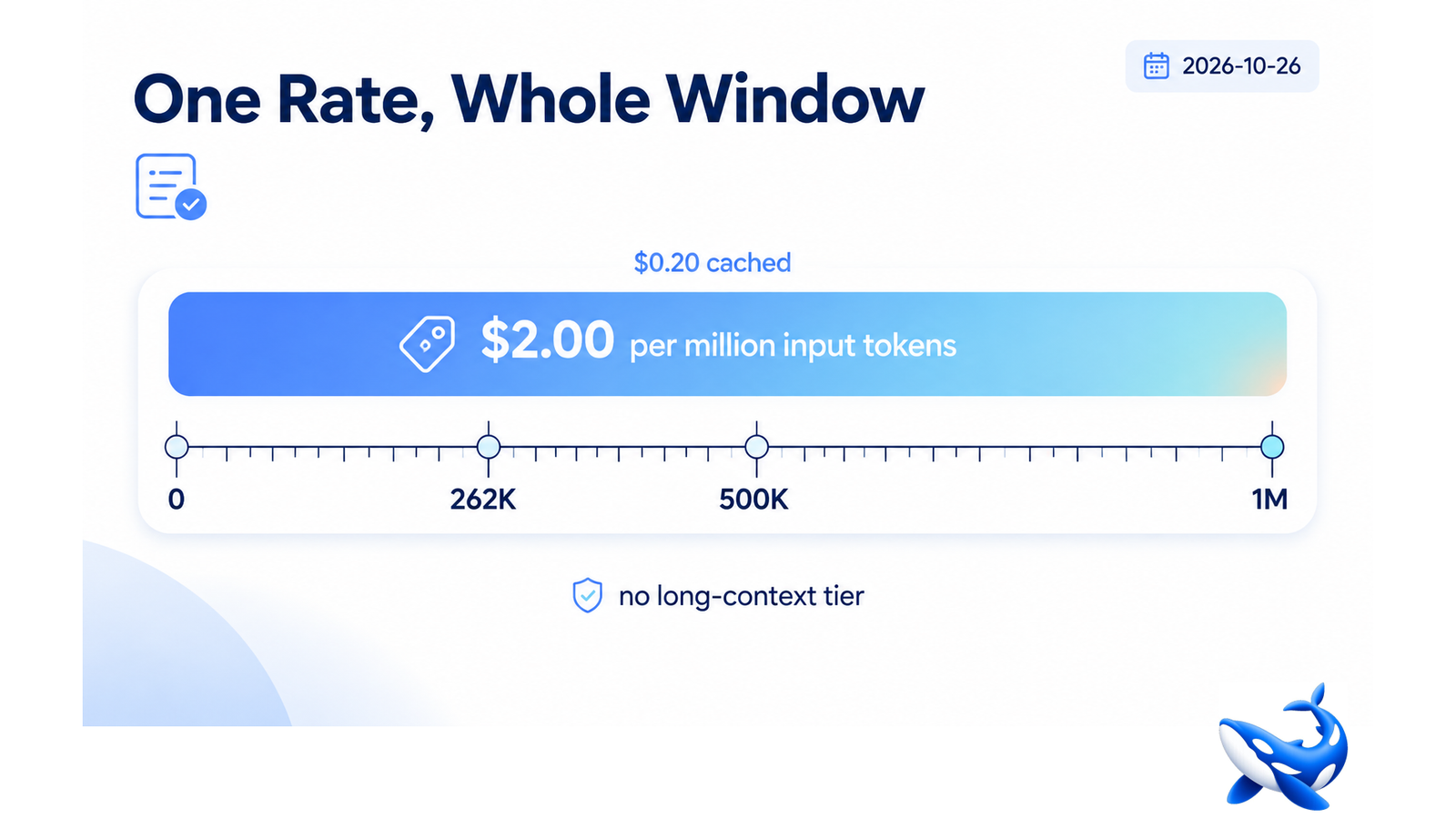

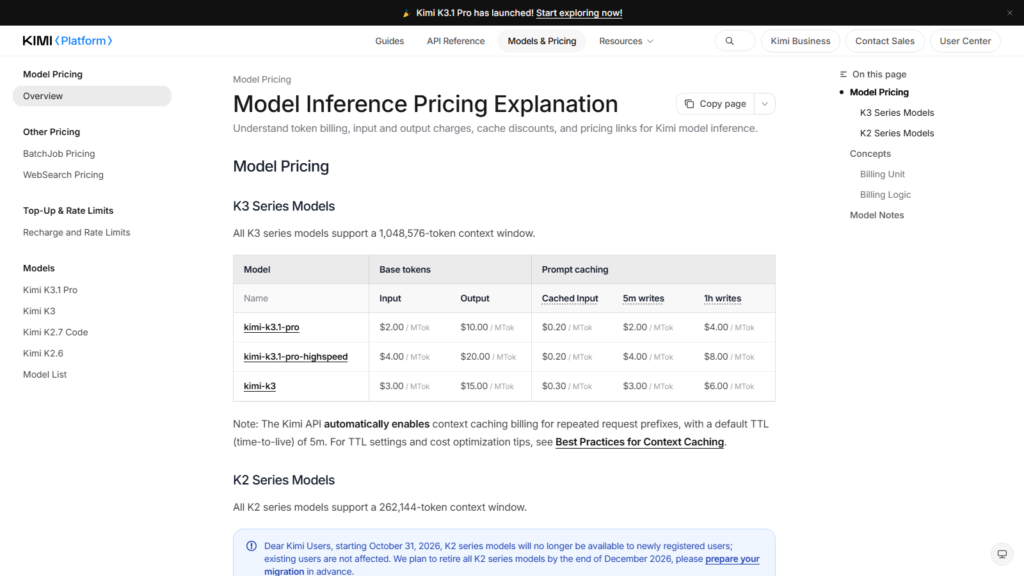
Kimi K3.1 Pro charges $2.00 per million input tokens at 200,000 tokens and at 1,048,576 tokens alike. There is no long-context tier, no surcharge above a threshold, and no premium for the last 800,000 tokens of the window [VENDOR]. OrcaRouter carries the Kimi K3.1 Pro pricing card at that same flat rate, passed through at list with no markup, and the cache read sits at $0.20 across the whole window too.
That sounds like the end of the article. It is actually the beginning, because a flat price per token does not mean a flat price per task. Long-context work is where this model’s cost profile is most counter-intuitive and where the two independent evaluations of it disagree most sharply with a naive reading of the rate card.
The arithmetic of a full window
| Request | Tokens read | Cost at $2.00/M | Cost if 90% cached |
| A 200K-token document | 200,000 | $0.40 | $0.22 |
| A 500K-token codebase | 500,000 | $1.00 | $0.46 |
| The full 1,048,576-token window | 1,048,576 | $2.10 | $0.86 |
Two dollars to read a million tokens is cheap enough that the instinct is to stop optimising. Resist it: the numbers above are per *request*, and long-context workloads are rarely one request.
What the independent tests show about token volume
The two published evaluations of this model both measured how much it reads, and both numbers are larger than teams expect.
Artificial Analysis: about 2,010,000 input tokens per task, of which roughly 1,900,000 were cache reads and 105,000 were cache writes [INDEPENDENT]. A single task reads two windows’ worth of tokens because it runs many turns, each re-sending the conversation.
Plotly, on a data-analytics exam: about 440,000 input tokens per question, 92% cached, alongside roughly 16,500 output tokens and about 7.5 model calls per question [INDEPENDENT].
Both tests describe the same behaviour: the model iterates. It reads, acts, re-reads and acts again, and each turn re-sends a context that the cache has already seen. That is why the effective input price on real traffic is nearer twenty-one cents than two dollars, and why the *number of turns* is the variable that controls the bill — more than the size of the window.
Flat window, uneven recall
The physical capability is 1,048,576 tokens. How much of it the model uses well is a different measurement, and it has an independent number: AA-LCR, long-context recall, 86.33% [INDEPENDENT].
That is the best score in our comparison set — above Claude Fable 5.1’s 85.33%, Claude Opus 5.5’s 84.67%, GPT-6.1 Sol’s 83.00%, Gemini 4 Argon’s 79.67% and GPT-6 Astra’s 80.67%. It is also, notably, below its own predecessor: Kimi K3 scores 88.67% on the same evaluation. The successor gives up 2.34 points of recall to gain 11.5 points of composite index.
Two conclusions follow, and they pull in opposite directions. The first is that this is a genuinely strong long-context model — first in its class on the recall measurement, which is the one that predicts whether a needle in a 700,000-token haystack is found. The second is that “1M context” is not a guarantee at the far edge: an 86% recall figure means about one in seven long-context probes is missed, and a workload that depends on retrieving one clause from a full window needs a retrieval layer in front of it, not faith.
Where a flat window changes design
Three workload shapes where the flat rate genuinely removes a constraint.
Whole-repository agents. A 900,000-token monorepo can be sent as one context on every turn without a chunking strategy. At the previous generation’s $3.00 rate the same pattern cost 50% more; at a long-context surcharge it costs multiples. This is the case the model is built for, and the cache makes it sustainable: a stable repository prefix is written once and read at $0.20 thereafter.
Document work with citations. Comparing six 100,000-token contracts in one request is inside the window and inside the price. What the model will not do reliably is recall a specific clause without it being in the prompt, so the pattern is “put everything in, ask for a diff”, not “ask what the contract says”.
Batch analysis with one big shared prefix. A fixed instruction set and schema of 300,000 tokens plus 10,000 independent queries is the cheapest possible use of this rate card: one cache write, then reads at a tenth of input. The query volume is nearly free relative to the fixed context.
A fourth shape worth naming: long transcripts. A support agent that carries a month of conversation inside one context pays the same rate at turn forty as at turn one, which is a pricing property no per-request tier can match — and one that turns “keep the whole history” from an architecture decision into a cost decision.
Where it does not
Single-shot questions over a big document. If the task reads a million tokens to answer one question, you are paying $2.10 (or $0.86 cached) for one answer, and a retrieval step that sends 8,000 tokens to a cheaper model will usually beat it on cost and often on accuracy — the model’s knowledge rows are its weakest, and a big context does not fix knowledge, it only relocates it.
Streaming chat with a growing transcript. Every turn appends, which means the prefix extends rather than changes, which is good for the cache — until a system prompt or tool schema edits the front and invalidates everything. The flat rate does not protect you from a $2.00 rewrite.
Workloads that lean on the last 200,000 tokens of the window. Recall at the far edge is the weakest part of an 86% average, and no price advantage compensates for a missed fact.
The one-paragraph version
Kimi K3.1 Pro’s 1,048,576-token window is priced flat from the first token to the last, which is a real and unusual advantage: the ceiling does not come with a surcharge, so the decision is about tokens consumed and recall achieved rather than about which tier you can afford. On real traffic it reads about two million tokens per task through cached turns at $0.20, which is why the effective price is a fifth of the rate card. On real traffic it also misses about one long-context probe in seven, which is why a retrieval layer is still cheaper than faith.
Sourcing note: the context window and the absence of a long-context surcharge are Moonshot’s published rate card and documentation, fetched 26 October 2026. Recall scores, per-task input token counts and the cache-split are Artificial Analysis on index v4.3.2, read the same day. The 92%-cached, 7.5-calls-per-question and 440K-token figures are Plotly’s single-run private benchmark. The request-level arithmetic table is ours, computed from the published rates; the workload recommendations are ours.
